All nonprescription, over-the-counter (OTC) medicine labels have detailed usage and warning information so consumers can properly choose and use the products.
Below is an example of what the new OTC medicine label looks like.
* Active Ingredient: Therapeutic substance in product; amount of active ingredient per unit.
* Uses: Symptoms or diseases the product will treat or prevent.
* Warnings: When not to use the product; conditions that may require advice from a doctor before taking the product; possible interactions or side effects; when to stop taking the product and when to contact a doctor; if you are pregnant or breastfeeding, seek guidance from a health care professional; keep product out of children’s reach.
* Inactive Ingredients: Substances such as colors or flavors.
* Purpose: Product action or category (such as antihistamine, antacid, or cough suppressant.
* Directions: Specific age categories, how much to take, how to take, and how often and how long to take.
* Other Information: How to store the product properly and required information about certain ingredients (such as the amount of calcium, potassium, or sodium the product contains)
Wednesday, August 5, 2009

Thursday, July 30, 2009
Labeling Requirements:
As a part of the registration process, the Department requires that a label for each brand, kind and size be submitted for approval prior to sale in the State of Maine. Labeling requirement are as follows:
* The deposit and refund value must not be less than 15 cents for wine and spirits, and 5 cents for all other beverages.
* On printed labels, the refund value and the word "Maine" or the abbreviation "ME" shall be clearly and conspicuously displayed on every beverage container using letters, numerals and symbols.
* The deposit logo must not be less than 1/8 inch high in clear and prominent typeface and a color contrasting with its background. The refund value shall not be indicated on the bottom of the container.
* On metal beverage containers the refund value and the word "Maine" or the abbreviation "ME" shall be embossed, incised, or printed clearly and conspicuously on the top of every beverage container using letters, numerals and symbols not less than 1/8 inch high.
* Additionally, if a manufacturer directly prints, embosses, or incises the Maine redemption value on the beverage container, the manufacturer or in the case of a private label, the brand owner must submit such labeled container, such as incised can or jet printed bottle to the Department of Agriculture, Food and Rural Resources, Division of Quality Assurance and Regulations for approval. Placement suitability and security of the mark will be examined.
* With the exception of wine products, all beverage containers sold in the State of Maine shall bear a Universal Product Code (UPC) for that product.
* Beverages, when sold as a multi-pack unit, must have a UPC on each individual beverage container.
* The deposit and refund value must not be less than 15 cents for wine and spirits, and 5 cents for all other beverages.
* On printed labels, the refund value and the word "Maine" or the abbreviation "ME" shall be clearly and conspicuously displayed on every beverage container using letters, numerals and symbols.
* The deposit logo must not be less than 1/8 inch high in clear and prominent typeface and a color contrasting with its background. The refund value shall not be indicated on the bottom of the container.
* On metal beverage containers the refund value and the word "Maine" or the abbreviation "ME" shall be embossed, incised, or printed clearly and conspicuously on the top of every beverage container using letters, numerals and symbols not less than 1/8 inch high.
* Additionally, if a manufacturer directly prints, embosses, or incises the Maine redemption value on the beverage container, the manufacturer or in the case of a private label, the brand owner must submit such labeled container, such as incised can or jet printed bottle to the Department of Agriculture, Food and Rural Resources, Division of Quality Assurance and Regulations for approval. Placement suitability and security of the mark will be examined.
* With the exception of wine products, all beverage containers sold in the State of Maine shall bear a Universal Product Code (UPC) for that product.
* Beverages, when sold as a multi-pack unit, must have a UPC on each individual beverage container.
Saturday, July 25, 2009
Collections of Bottles from 1800 to 1860
Types of bottles in the collection include: bitters, ale, beer, food, household items, ink, liquor, oil, patent medicine, perfumes, cosmetics, pharmacy medicine, snuff, soda water, wine, and champagne. The bottles assembled in this type collection are drawn from numerous extensive archaeological collections including Old Sacramento SHP, Fort Ross SHP, Columbia SHP, San Juan Bautista SHP, Old Town San Diego SHP, and Sonoma SHP.
Fernet-Branca Bitters:

This Fernet-Branca Bitters bottle was recovered from Columbia SHP; however, 18 additional shoulder seals have also been recovered in Old Sacramento SHP. The firm was founded in Milan in 1845 by the three brothers Giuseppe, Luigi and Stefano Branca. This bottle is made of olive glass, with a double ring on the finish and high push-up. The shoulder seal is embossed "FRATELLI BRANCA/MILANO."

Bottle of Fleming's Export Rye is made of clear glass with a lady's-leg neck and an applied bead lip. Embossed on two sides is "FLEMING'S EXPORT PURE RYE//BOTTLED EXPRESSLY FOR FAMILY USE." Export Pure Rye is thought to have been manufactured by Joseph Fleming, in Pittsburgh, Pennsylvania, who was a druggist from 1856 to 1920.
Udolpho Wolfe's Schnapps:
 This bottle of Udolpho Wolfe's Schnapps, a Holland medicinal gin, is made from dark olive green glass with a sloping-collar finish and is embossed with "VONTHOFEN'S/ SCHEIDAM/ S/ NAPPS./ TIC" on the body. Uldolpho and Joel Wolfe introduced their product to the American public prior to 1849. This bottle was recovered from Old Town San Diego SHP in 1984.

Napa Soda Water was bottled at the site of natural springs in the Napa Valley, California. The springs
were discovered in 1853 and originally owned by John Henry Woods. Colonel John P. Jackson took ownership in 1872 after many court disputes. This bottle is made from clear glass with a sloping-collar finish and is embossed with "JACKSON'S NAPA SODA WATER" AND "NATURAL MINERAL WATER/CARBONATED/JACKSON'S/THIS BOTTLE IS NEVER SOLD".This bottle of Jackson's Napa Soda Water was recovered from Old Sacramento SHP in 1966.
Vaseline Chesebrough :

In 1859 chemist Robert Chesebrough was the first to extract the key ingredient of petroleum jelly, petrolatum, from a substance left on oil drill rigs. This jar of Vaseline Chesebrough is made from clear glass and embossed with "TRADE MARK/ VASELINE/ CHESEBROUGH/
Singer Sewing Machine Oil:

The first practical sewing machine was developed by Isaac Merrit Singer in Boston, Massachusetts, 1850. One year later, Singer and Edward B. Clark formed I.M. Singer & Company. In 1863 the company was incorporated as Singer Manufacturing Company. This bottle is rectangular, made of clear glass and embossed with the Singer "S" logo and "SINGER MANUFACTURING CO./TRADE MARK" on the front.

Thursday, July 16, 2009
Soda Bottles
These bottles used in beer, mineral water, soft drinks, or fruit drinks. All of these bottles we call today "Deposit Bottles". Each bottle was the property of the bottler, and when you finished with the drink you where to return the bottle. There are five basic categories of these bottles, and each can easily be recognized by its shape, mostly by its top. An example of each is shown below. They are "Blob top", "Gravitating Stopper", "Crown top", "Hutch", and "Squat". The squats have two different types of tops: "Blob" (sometimes called "Pony"), and "Tapered Skirt"
 Squat Blob o Pony
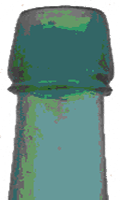 Squat Tapered Skirt
 Hutch
Hutch
 Crown Top
 Gravitating Stopper
 Blob
Blob
 Squat Blob o Pony
 Squat Tapered Skirt
 Hutch
Hutch Crown Top
 Gravitating Stopper
 Blob
Blob
Thursday, July 9, 2009
How to examine a Wine Label
 Brand- Used by the bottler to recognize the product. Any name is suitable as chosen by the bottler as long as it is not misleading to the consumer.
Vintage- Ninety-five percent or more grapes in the wine were grown in that year.
Appellation of Origin- The name of the place in which the greater part of the grapes in the wine were grown.
Viticultural Area- An area that is a grape-growing area with soil, climate, history and geographical features that distinguish it from the areas around it.
Net Contents- The quantity of the product in the container in metric units.
Varietal Designations- The name of the leading grapes in the wine. Merlot, Chardonnay, Cabernet Sauvignon, and Zinfandel are the example. A varietals designation means that at least 75 % of the grapes used in the wine are of that mixture.
Estate Bottled- One hundred percent of the wine came from grapes grown on land prohibited or owned by the winery. The winery must complete the complete wine making process on their premises.
Name and Address- The bottler or importer's name or trade name and address should appear on the wine label. If the wine is imported, it should be followed by the name and address of the importer.
Country of Origin- Necessary for all imported wines, for example "Product of (name of country)".
Alcohol Content- Alcohol content in percent by volume must show on the wine label.
Declaration of Sulfites- Necessary if the wine contains 10 or more parts per million of sulfur dioxide.
Health Warning Statement- "GOVERNMENT WARNING" should appear on all alcoholic beverages containing .5% or more alcohol.
Monday, July 6, 2009
GMO Food Labeling Regulations
 The policy is expressed in the Regulations Relating to the Labeling of Foodstuffs Obtained Through Certain Techniques of Genetic Modification that were made in terms of the Foodstuffs, Cosmetics and Disinfectants Act.
These regulations require the following:
1. Mandatory:
- A genetically modified (GM) food must be labeled as such if it differs significantly in composition, nutritional value, or mode of storage, preparation or cooking from that of the corresponding existing foodstuff.
- The label of the genetically modified food must indicate the likelihood of allergenicity if the novel gene is derived from any of the following donor organisms: crustaceans, eggs, fish, groundnuts, milk, molluscs, soybeans, tree nuts or wheat (food safety).
- The food must be labeled as such if a plant-derived food contains genetic material derived from a human or from an animal, or if animal-derived food contains genetic material derived from a human or from a different taxonomic animal family.
2. Voluntary:
A claim relating to improved or enhanced characteristics of a genetically modified food must be validated and certified by a competent body which is accredited by the Accredited System and the name of the certifying body must appear on the label in close proximity to the claim.
Thursday, June 25, 2009
Bill Hunt's Medicine Bottle Glass Index
This database is a reference to aid in the identification of embossed medicine bottles. It is equally appropriate for researching complete labels as well as bottle label fragments and is suitable for use by bottle collectors as well as historical archeologists. The finding aid is available as a Microsoft Word document or as a text file. The data file was built as a text file to allow the researcher to employ word processing software text finding aides (a "word search") to locate strings of letters, complete words, or combinations of words which appear on a bottle or bottle fragment. It includes about 6,080 entries. The embossed label listing was compiled using information from 38 archeological reports and popular bottle publications. Printed labels were not used in the data file's compilation.
|  About this bottle About this bottle | |
This finding aid has proven itself to be an extremely rapid means of identifying an embossed medical bottle or fragment and sources of information for that specimen. Where once it may have taken hours or days to sort through the published materials, now only minutes are required to either locate a label or establish that it is unlisted in the designated sources. The database will be updated as entry errors and additional published information are provided by users. | ||
Subscribe to:
Posts (Atom)